



We’re always stronger together—and that includes the effort to fix our system of education and job training.
And after serving on a panel at the National Conference of State Legislatures, I’m more confident than ever that we can work together for the whole country’s benefit.
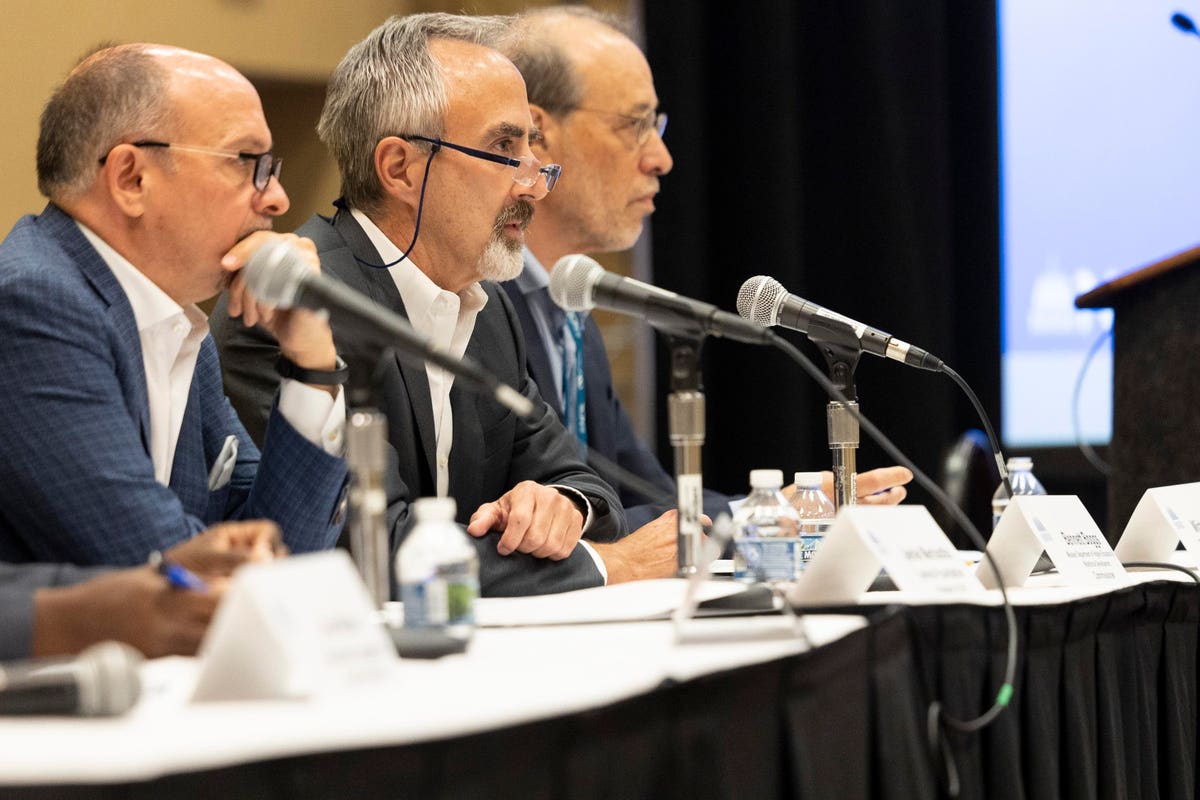
The NCSL’s late August summit in Indianapolis included a panel discussion called, “A Bipartisan Vision to Improve Higher Education.”
I joined Yolanda Watson Spiva, president of Complete College America, and Bennett Boggs, commissioner of the Missouri Department of Higher Education and Workforce Development. The moderators were Utah state Sen. Ann Millner, a Republican, and Oregon state Sen. Michael Dembrow, a Democrat.
It was good to hear that people from different parts of the country and different political parties have a shared understanding of the importance of education beyond high school and the challenges confronting America’s colleges and universities.
To me this signals that in the face of partisan rancor, including in higher ed, there are still areas of potential agreement. And we know that’s partly from the bipartisan efforts of Sen. Millner and Sen. Dembrow, and their work on the NCSL’s Higher Education Task Force.
Higher ed’s challenges are daunting, to be sure. We know, for example, that as of last year there were 4 million fewer Americans enrolled in college than a decade earlier. We know the rate of students going to college following graduation from high school declined from 70 percent to 62 percent between 2016 and 2020.
There are other signs that faith in higher education has fallen. In 2015, a Gallup poll showed that 56 percent of Americans had “a great deal” or “quite a lot” of confidence in higher ed. Now, a similar Gallup poll shows that only 36 percent have those levels of assurance.
The skepticism exists despite considerable evidence around the growing importance of education. Georgetown University’s Center on Education and the Workforce estimates that, by 2031, 72 percent of all American jobs will go to workers who have schooling beyond high school. Even more compelling: Just under 85 percent of “good” jobs—that is, jobs paying at least $38,000 for younger workers and $49,000 for those between 45 and 64— will go to workers with college educations.
Why, then, do so few Americans value higher education? The panel agreed that colleges and universities need to do a better job of meeting students where they are. Much of the reason so many Americans question college’s value is that the promised rewards often seem distant, even abstract, while the obstacles are immediate—and daunting.
Some of those obstacles are huge. As we on the panel talked, a screen in the room rotated through a series of slides regarding higher education’s challenges. One slide showed that the average graduate leaves college $45,000 in debt. Other sources, including the Education Data Initiative, put average student debt between $29,000 and $37,000.
Whatever the exact number, the rising cost of college is a burden for anyone—especially a young person trying to start a life and career. Such debt delays or eliminates options and opportunities for millions of Americans.
Other obstacles are more basic. My fellow panelist Ben Boggs pointed out that even the placement of bus stops can serve as a deterrent. Even if overwhelming evidence shows that schooling will help a single parent bring in more income for their family, the prospect of walking five blocks through stormy weather from a bus stop to the classroom can be a deal-breaker.
Under the direction of Yolanda Watson Spiva, Complete College America has helped lead the way in thinking about how to better support students, including CCA’s recent webinar on advancing college completion and equity through dual enrollment. CCA has also done important work on the challenges facing part-time students—who really should, as the group says, be a full-time priority.
As we look for ways to remove the many obstacles facing students, we need to work wisely—focusing our efforts where they’ll do the most good. That means shifting our thinking away from elite, selective colleges and universities—which serve only 10 percent of the nation’s college students. The goal must be to build a higher education structure that provides access and opportunities for all Americans.
One of the heartening things about the NCSL panel was seeing legislators’ willingness to consider sweeping new ways to meet the challenges facing higher ed and the states.
Boggs was there in part because of just such an experiment in his state. Missouri just combined its commission for higher education and its office of workforce development—and put him in charge of it.
And the new Missouri Department of Higher Education and Workforce Development just announced a one-year, $1 million grant to the University of Missouri to support what’s being called the “fourth industrial revolution.” The effort, driven by technological advancements such as artificial intelligence, includes a digital-first approach to engineering. The university’s Industry 4.0 lab is scheduled to open in the College of Engineering next fall.
Missouri’s effort to foster greater collaboration between its higher ed and workforce offices echoes a proposal I made a few years ago in my book “America Needs Talent.” I suggested that the federal government create a U.S. Talent Department by combining the Department of Education with the Labor Department’s Employment and Training Administration, and the talent recruitment functions of other agencies.
The hope here, and I think the Show-Me State will show us, is that higher ed can coordinate more effectively with efforts to attract, train, and retain good workers, achieving economies of scale in the process.
This is the kind of thinking we need across the board to improve our colleges and universities. We need to find ways to fund post-high school education that do not saddle students with crippling debt. And we must create more and better pathways to higher education and ensure that colleges meet and engage today’s students—whatever their age, demography, or socioeconomic status.
I know these are weighty problems that defy easy answers, but the potential payoff is enormous. Just consider how, when properly motivated—say, by the prospect of moving millions of Americans to economic security while ensuring the nation’s supply of talent—people who generally disagree can work together for the benefit of all.
I saw some of that spirit at the National Conference of State Legislatures, and I’m optimistic that we’re turning an important corner.
Read the full article here