



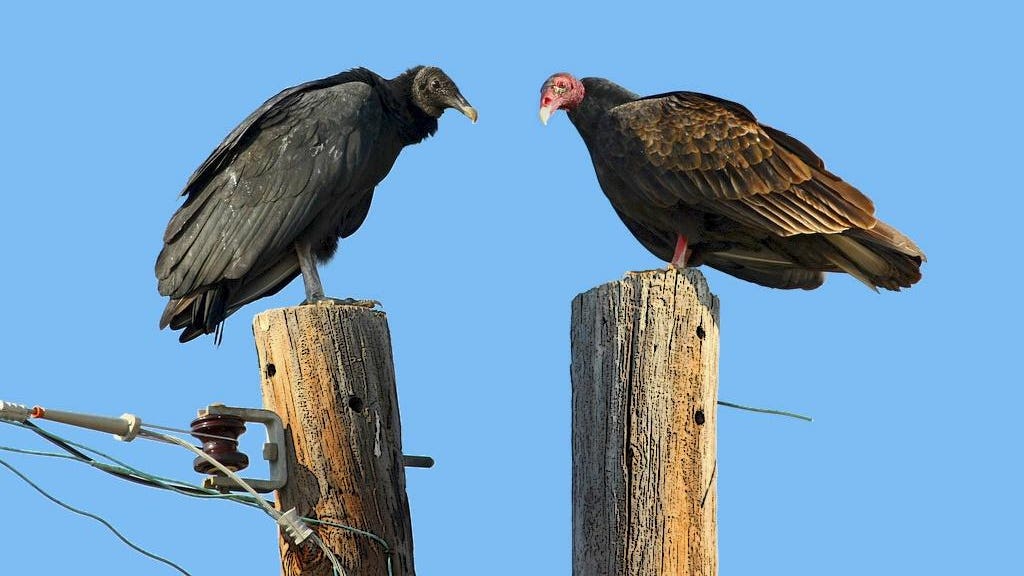
A common question posed to ornithology professors, birders and birding guides that has a surprisingly complicated answer
© Copyright by GrrlScientist | hosted by Forbes | LinkTr.ee
As a former birding guide, one question that I was often asked was why do turkey vultures have red heads and pale beaks whilst black vultures have black heads and beaks? In the eyes of most casual observers, these two vultures look much alike, except the colors of their heads, which provide a sort of color-coding for quickly distinguishing the two species. Why do they have this obvious color difference? Are there advantages associated with one color versus the other?
From an adaptive point of view, color can serve several functions in animals, and frequently represents a trade-off amongst different evolutionary drivers. These trade-offs can vary between individuals within the same population, and color can even be altered to serve very different purposes, such as thermoregulation and communication.
It is usually assumed that the skin coloration of black vultures, Coragyps atratus, is the result of skin cells containing eumelanins, a group of brown-black pigments in the upper layer of skin (or epidermis) that act as a sunscreen capable of efficiently absorbing UV photons, but how red skin coloration is created in turkey vultures, Cathartes aura, and what adaptive purposes this serves remains mysterious and unexplored (ref).
Adding to the confusion, scientists have found a variety of biochemical mechanisms and processes underlying the creation of colors that look alike, but actually aren’t the same at all. For example, birds create red skin color in several ways. They may, for example, deposit a variety of red pigments (carotenoids) into their skin, or they may blush and thereby turn their skin red by passing highly oxygenated blood near the skin surface — sometimes in combination with carotenoids (ref). As an added bonus, skin blushing is useful for communication with a bird’s social partners and companions, and can be used by some bird species in dominance or courtship displays, too (more here).
To explore the anatomy and physiology of the head skin colors in these two species of New World vultures, a team of scientists from Auburn University and Mississippi State University collaborated to use a variety of techniques to investigate this question.
To do this work, the researchers trapped seven wild black vultures and seven wild turkey vultures at two sites in Mississippi. Along with obtaining a small blood sample, they collected a small skin sample from each bird. Back in the lab, the researchers then measured the color of the skin samples using spectroscopy, examined the structure of the skin samples using light microscopy, and quantified the concentration of carotenoids present in the skin and blood of each species. Spectroscopy identified eumelanin as being responsible for the black coloration of the black vulture skin, as predicted, and that hemoglobin is primarily responsible for the red coloration of the turkey vulture skin.
When tissue concentrations of pigments were evaluated and compared between the two species, the researchers found that turkey vulture skin accumulated significantly more carotenoids than black vultures. But once again, they found that hemoglobin — and not carotenoids — is the main pigment responsible for the red coloration of the turkey vulture’s head skin, whilst eumelanin is the source for the coloration of the black vulture’s black head skin.
This might make you wonder why adult turkey vultures have higher concentrations of skin carotenoids compared to adult black vultures if these molecules aren’t used to create red color? It’s possible that the increased concentration of carotenoids in turkey vulture skin may compensate for the lack of melanin in their skin cells and help protect against the damaging effects of high levels of UV radiation that turkey vultures are exposed to whilst soaring in direct sunlight for long periods of time. In contrast, black vultures, which also soar for long periods, have high levels of eumelanins in their skin cells that act as a biological sunscreen, so they are already protected from UV radiation and probably won’t benefit from the added protection of carotenoids.
There may be other evolutionary functions for the red head color of turkey vultures. For example, turkey vultures don’t attain their bright red coloration until the bird reaches adulthood; juveniles have a dark gray head and sometimes are mistaken (by birders) for black vultures. This red color may indicate to other turkey vultures that a particular bird is mature. Additionally, because turkey vultures are highly social, often roosting in large numbers, they may use blushing of their head skin as a nonviolent way to communicate with others.
Source:
Nicholas M. Justyn, Matthew J. Powers, Geoffrey E. Hill, Kayla Alexander, Adrián Naveda-Rodríguez, and Scott A.Rush (2022). The mechanisms of color production in black skin versus red skin on the heads of New World vultures, Avian Research 14:100071 | doi:10.1016/j.avrs.2022.100071
SHA-256: 9ab94921e06b203a216cb219d873f92ea4083642075e2e0be632939cd42949aa
Socials: Bluesky | CounterSocial | LinkedIn | Mastodon | MeWe | Post.News | Spoutible | SubStack | Tribel | Tumblr | Twitter
Read the full article here