



Now that the smoke has cleared on the surprising success of Oppenheimer, the film, it only seems natural to take an eagle’s eye look at a few key takeaways from the renowned American physicist’s leadership style.
J. Robert Oppenheimer’s assignment at the Manhattan Project’s Los Alamos, New Mexico laboratory was to create a practical and deployable atomic bomb. The idea was to generate a fast-neutron chain reaction in a device that would harness the destructive power of nuclear fission. That is, the process by which a subatomic neutron slams into a larger atom, exciting it enough to fission (or split) into two smaller atoms.
There are three basic leadership skills that Oppenheimer used during his tenure as director at the Top-Secret World War II-era U.S. Army lab.
—- The first is that, at the young age of 39, he had enough ambition and confidence to lead a group of Nobel Prize-winning scientists in an operation unlike the world has ever seen.
—- Secondly, he won people over through his personal charm and arguably, most importantly, his sheer ability to persuade others.
—- And, finally, he was single-minded in his desire to complete the task to which he had been assigned.
As For What Drove Him?
Oppenheimer apparently loved the challenge of solving intricate scientific and technical problems.
“If you are a scientist you believe that it is good to find out how the world works; that it is good to find out what the realities are; that it is good to turn over to mankind at large the greatest possible power to control the world and to deal with it according to its lights and its values,” Oppenheimer noted in a 1945 postwar speech in Los Alamos.
A Theorist Ahead Of His Time
As a young professor of physics in the 1930s, Oppenheimer had made a name for himself at the University of California at Berkeley as someone who pushed his students to the cutting edge of scientific theory.
Oppenheimer, himself, never got the recognition that he and colleagues’ groundbreaking pre-war theoretical work on stellar mass black holes. Caused by the core collapse supernovae of a massive stars, it would take a few more decades before observational astronomers confirmed Oppenheimer’s slide-rule calculations that supernovae do create stellar mass black holes.
World War II Intervened
Oppenheimer, ironically, was recruited for the Manhattan Project by U.S. Army Maj. Gen. Leslie Groves, an engineer by training who understood the difficulties of such a complicated undertaking. Many of Oppenheimer’s colleagues were surprised when Groves chose Oppenheimer, a theorist instead of an engineer or physicist to head up the Los Alamos lab. But the major general must have seen the potential for Oppenheimer to be an effective leader.
For one thing, Groves was impressed with Oppenheimer’s realization that the building of such an atomic weapon would inherently require an interdisciplinary approach.
“Oppenheimer envisioned four broad divisions within the laboratory: experimental physics, theoretical physics, chemistry and metallurgy, and, finally, ordnance,” Kai Bird and Martin J. Sherwin note in their 2005 book, American Prometheus: The Triumph and Tragedy of J. Robert Oppenheimer. “Group leaders within each of these divisions would report to the division chiefs, and the division chiefs would report to Oppenheimer,” they write.
A Bit Like Herding Cats
Oppenheimer’s capacity for marshaling such a disparate group of scientists to work as a team under the most challenging of circumstances was nothing less than extraordinary. Creature comforts inside the Los Alamos camp were almost non-existent. And the day-to-day intellectual pressure to get it done yesterday took its toll.
But most of all, Oppenheimer was a man doing what was asked of him for the country that he loved.
“I did my job which was the job I was supposed to do,” Oppenheimer told a 1954 U.S. government hearing in Washington, D.C. “I was not in a policymaking position at Los Alamos. I would have done anything that I was asked to do, including making the bombs in a different shape, if I had thought it was technically feasible.”
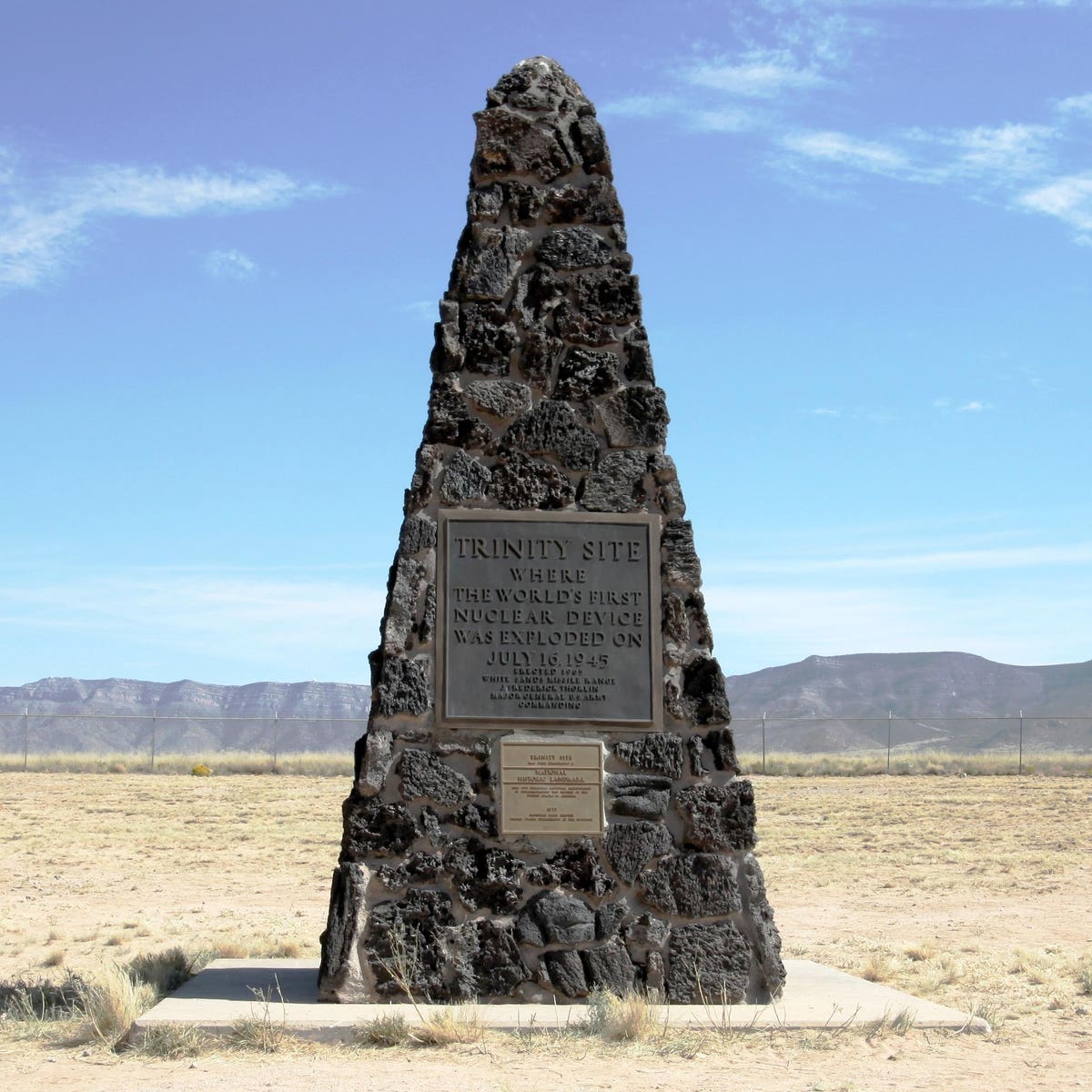
Trinity was the code name Oppenheimer bestowed upon the U.S. Army’s first atomic test which took place on the barren plains of New Mexico’s Jornada del Muerto Desert. There, at 5.29 AM local time on July 16, 1945, a blinding flash lit the sky followed by a mushroom cloud 41,000 feet high.
Global Geopolitics Would Never Be The Same
Even at a significant distance from the test site, “The horses in the MP stable still whinnied in fright; the paddles of the dusty Aer motor windmill at Base Camp still spun away the energy of the blast; the frogs had ceased to make love in the puddles,” Richard Rhodes writes in his 1986 book, The Making of the Atomic Bomb.
But despite all the postwar hype about the benefits of the atomic age, in the end, one can’t help but be ambivalent about the development of such a gruesome weapon. Physics in a utopian society would allow all the benefits of nuclear energy without the risk of such power falling into malevolent hands. But any civilization that begins to understand the forces of the cosmos will soon learn to harness its raw power.
I’m always amused at the idea put forth in some circles that intelligent space aliens would come all the way to Earth to try to stop us from using nuclear weapons. As if our sudden ability to build the bomb would be of any threat to them whatsoever.
In truth, the universe is full of natural high-energy events capable of wiping out whole societies in the blink of an eye. Our own star’s atomic fusion makes any nuclear output put together here on Earth look puny indeed.
Oppenheimer may have summed it up best in a 1953 lecture, when he said, “We will have to accept the fact that no one of us really will ever know very much.”
Read the full article here