



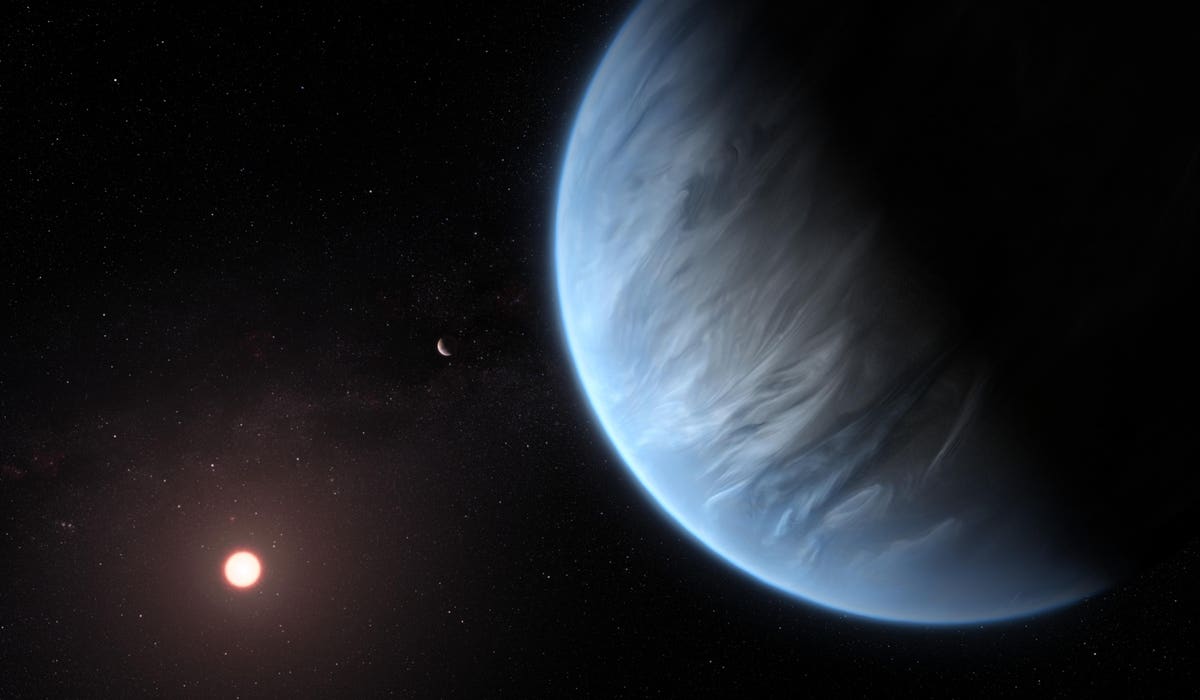
Scientists using the Webb Space Telescope have identified a molecule in the atmosphere of another planet that could potentially be a sign of life.
During just two observations evidence was found for dimethyl sulfide (DMS) in the atmosphere of K2-18 b, a giant “sub-Neptune” planet about 120 light-years from the solar system in the constellation Leo.
On Earth, DMS is largely a by-product of phytoplankton. However, its detection is preliminary and “requires further validation,” according to the authors of a paper due to be published in The Astrophysical Journal Letters.
Preliminary Findings
“Upcoming Webb observations should be able to confirm if DMS is indeed present in the atmosphere of K2-18 b at significant levels,” said Nikku Madhusudhan, an astronomer at the University of Cambridge and lead author of the paper.
The researchers analyzed light from K2-18 b’s host star as it passed through the exoplanet’s atmosphere. Webb’s unique ability to see in the infrared coupled with its incredible sensitivity were pivotal.
The ultimate goal of this work is the identification of life on a habitable exoplanet.
Exciting Exoplanet
This is not the first time K2-18 b has grabbed the headlines. An exoplanet 8.6 times as massive as Earth that orbits a cool red dwarf star called K2-18, it was discovered by NASA’s Kepler Space Telescope in 2015. Here’s why it’s exciting:
- It’s positioned in the star’s habitable zone—an orbit around a star close enough to make liquid water possible on the surface of a rocky planet.
- In 2019 the Hubble Space Telescope found evidence for water vapor in its atmosphere.
- The new research also revealed the presence of carbon-bearing molecules including methane and carbon dioxide.
- The abundance of methane and carbon dioxide and shortage of ammonia suggests that there may be an ocean underneath a hydrogen-rich atmosphere—a so-called “Hycean” exoplanet.
Diverse Environments
However, not only does it mass mean that its surface gravity would be significantly higher than on Earth, but host star K2-18 is known to be extremley active. The surface of K2-18b is therefore likelly to be frequently drenched in high-energy radiation, creating a hostile environment for life. It’s also likely that the planet’s interior contains a large mantle of high-pressure ice, like Neptune, and that any ocean is too hot to be habitable.
“Our findings underscore the importance of considering diverse habitable environments in the search for life elsewhere,” said Madhusudhan. “Traditionally, the search for life on exoplanets has focused primarily on smaller rocky planets, but the larger Hycean worlds are significantly more conducive to atmospheric observations.”
What Happens Next
Although there isn’t an example in our solar system, sub-Neptunes appear to be the most common type of planet in the Milky Way.
More observations of K2-18 b are planned with Webb’s Mid-Infrared Instrument, said team member Savvas Constantinou of the University of Cambridge, who added: “This means our work here is but an early demonstration of what Webb can observe in habitable-zone exoplanets.”
Wishing you clear skies and wide eyes.
Read the full article here