


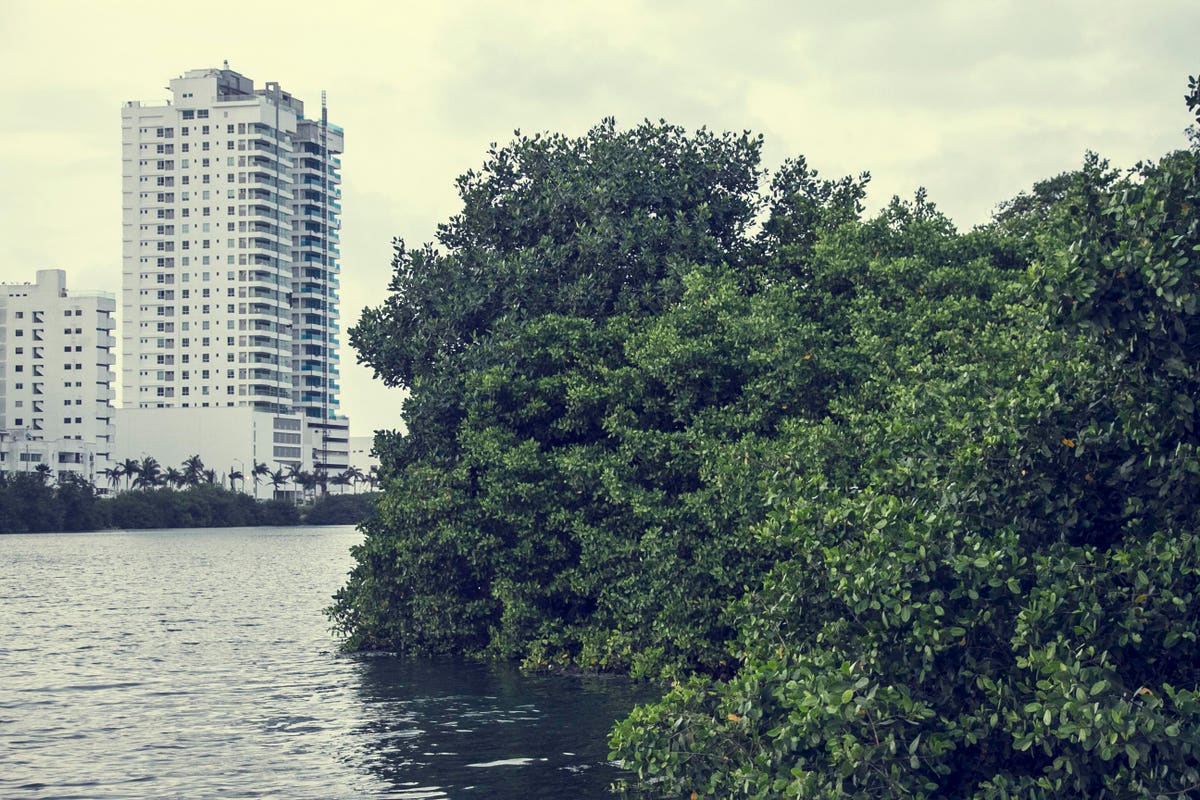
Cartagena is a buzzing tourist city in northern Colombia, but hiding in plain sight is a rare species of mangrove, providing essential ecosystem services.
According to a 2020 study, between 2000 and 2016, human activity was the primary driver of mangrove area loss, with expanding coastal cities (urbanization) being a key factor.
Karla Ramírez-Ruiz, a master’s student of the Erasmus Mundus Joint Master Degree in Tropical Biodiversity and Ecosystem (TROPIMUNDO), says that researchers were looking at records of the Piñuelo mangrove (Pelliciera spp.), a very rare and endangered genus of mangroves that occur in limited stands found in South and Central America.
“Soon, we realize that most of the 20th century historical records of Pelliciera spp. in Colombia were in Cartagena city and other urban areas in the Caribbean,” she says, adding that the researchers began to see cities more as highly human-modified ecosystems.
Ramírez-Ruiz explains that her current main scientific question focuses on the effects of urbanization and fragmentation on mangrove forest ecosystems in the context of climate change.
“Urbanization has been overlooked by biologists, despite cities are driving rapid eco-evolutionary changes on organisms living in and besides them,” she says, adding that the impacts of urbanization, such as habitat fragmentation, are likely to interact with the effects of climate change to drive additional landscape change.
“Obtaining information on how they will respond and have responded will help us better plan for conservation and adapt to the upcoming global changes,” Ramirez-Ruiz says.
In the Caribbean basin, specifically Urabá Gulf, Morrosquillo Gulf, and two bays in Cartagena, each showing a different degrees of human-driven impact within the three regions of Colombia’s Caribbean coast.
The research would result in the article “Threatened Mangroves in the Anthropocene: Habitat Fragmentation in Urban Coastalscapes of Pelliciera spp. (Tetrameristaceae) in Northern South America” in the journal Frontiers in Marine Science.
From Mountains to Mangroves
Ramirez-Ruiz grew up among the mountains, in a small valley town in the Colombian Andes, which she describes as 2300 meters “closer to the stars”.
“I used to visit my grandparents every holiday and spend my days milking the cows, collecting firewood and eggs, playing in the mud, and walking through the forest,” she says, “I got fascinated and passionate about the forest, developing a strong sensitivity to environmental issues and those holidays later determined my career path, leading me to make the decision to work in the forest and protect it.”
Ramirez-Ruiz says that given she was the first in her family to go to university, it took her a while to find the career path that was a good fit for her.
“Then, I met a biologist that used to work surveying birds and I knew that was the right choice for me,” she says, “My family, especially my mom, supported me and encouraged me to follow my heart and my dreams despite everyone else’s comments.”
After finishing her bachelor degree at the University de Antioquia in Medellin, Colombia, Ramirez-Ruiz entered the Erasmus Mundus Joint Master Degree in Tropical Biodiversity and Ecosystems in Belgium.
Ramirez-Ruiz says that as a scientist from the Global South, she feels true scientific objectivity and creativity will not emerge from a homogeneous group with similar perspectives.
“It is more likely to arise when individuals from different backgrounds and perspectives come together, encompassing the global south, diverse social classes, gender, and sexual orientations, and the full range of human diversity,” she says.
Challenges of Urbanization
It isn’t just the coastal cities where urbanization presents a threat to native species. In Manizales, perched in the Colombian Andes, researchers are studying how a native species of small fresh-water crabs is faring in the city’s parks and streams.
Juan Mateo Rivera Pérez, a doctoral student in ecology at the Federal University of Pará (UFPA) Belém, Brazil and first author of a June 2023 paper in the journal Aquatic Ecology says the project was the first to determine and compare the ecological niche of freshwater crabs of the Strengeriana fuhrmanni species in Colombia.
“I am currently working to understand how anthropogenic changes, such as urbanization, agriculture, and livestock are affecting populations of endemic crabs of the Pseudothelphusidae family,” he says, adding that although crabs are sensitive to change and are often noted in environmental quality studies, they were never prioritized.
Read the full article here