



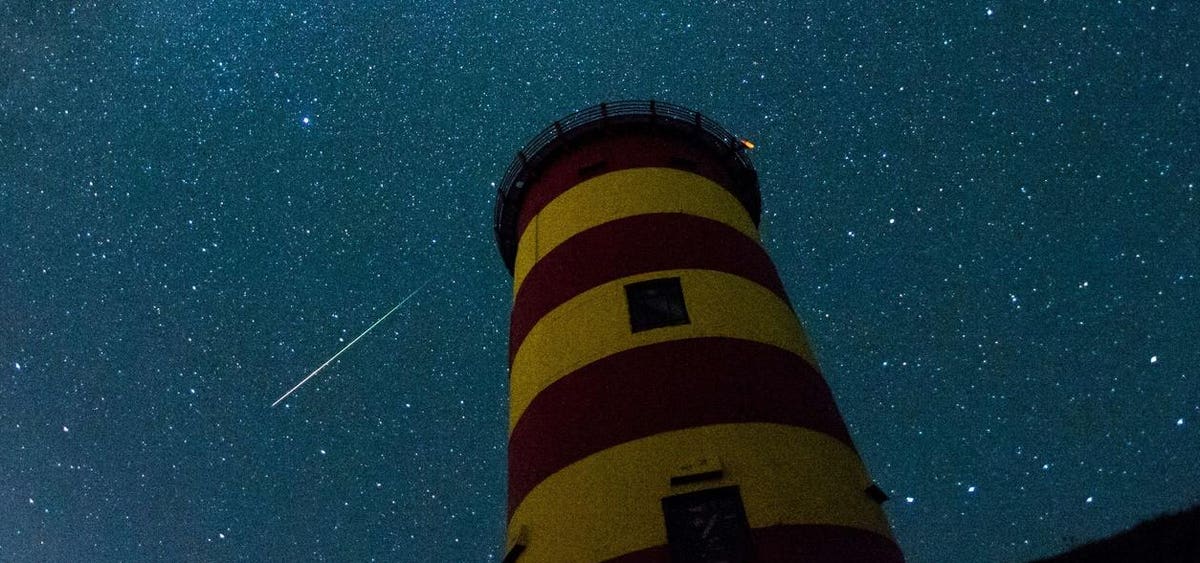
We’re on the cusp of the peak of the Perseids meteor shower, the most impressive and most watched display of “shooting stars” of the year.
Here are six things you didn’t know about this stream of dust in space—including some useful tips on exactly when to watch the Perseids peak in 2023.
1. The Peak Lasts For 16 Hours
There’s a sharp increase in activity on peak night. The actual peak this year is predicted to occur at 04:00 Universal Time on Sunday, August 13. That translates to:
- 12:00 a.m. EDT on Sunday, August 13.
- 11 p.m. CDT on Saturday, August 12.
- 9 p.m. EDT on Saturday, August 12.
- 10 p.m. MDT on Saturday, August 12.
- 9 p.m. PDT on Saturday, August 12.
However, there’s often enhanced activity for 16 hours—eight hours either side of the peak time—according to Sky At Night. Activity falls by 50% outside of this window. The best time within this peak is when Perseus is high in a dark sky—so from about midnight through 4:00 a.m. wherever you are in the northern hemisphere, but anytime after it gets dark on Saturday, August 12 is good.
2. Christians Called it the ‘Tears of St Lawrence’
The Perseids roughly coincides with the feast day of St. Lawrence, a Catholic deacon in Rome in the third century A.D. who was murdered by the Roman authorities. In medieval Europe, the annual meteor display thus became known as the “Tears of St. Lawrence,” according to Cosmic Pursuits.
3. It Only Rages Above the Equator
The radiant point (apparent source) of each “shooting star” is the constellation of Perseus. It’s precisely at this region of the night sky that meteors appear to strike Earth’s atmosphere. To see the Perseids, the observer must be on the night-side of Earth and have Perseus high in the sky, which gives the northern hemisphere a much better view than those below the equator.
4. It’s Refreshed Every 133 years
The Perseids meteor shower is the result of Earth crashing into the dust and debris left in the inner solar system by comet 109P/Swift–Tuttle, which has a nucleus 16 miles wide. It loops around the sun every 133 years.
As it gets close to the sun it melts a little, shedding material that could one day rain down on Earth as “shooting stars”—though only if the comet’s path crosses Earth’s annual orbital path around the sun. Since 109P/Swift–Tuttle’s path is close to Earth’s, its material is grabbed by our planet’s gravitational field.
The link between the frequently observed meteor shower and 109P/Swift–Tuttle wasn’t made until 1862 by Italian astronomer Giovanni Schiaparelli.
5. Keep Expectations in Check
The so-called zenithal hourly rate (ZHR) for the Perseids is often quoted as 150 meteors per hours. Wow! That’s one every 20 seconds during the peak hour. Well, theoretically, yes, but to have any chance at all of seeing 150 in an hour you would have to have a 360º view of as dark a sky as it’s possible to get … and have dozens of eyes.
In practice, Perseids—and all “shooting stars”—are blink-and-you’ll-miss-them affairs. Besides, most of us will be in light-polluted backyards and parks, not remote and arid deserts. Perseids are often bright with long trails—and occasionally you’ll see a bright “fireball”—but be happy with a dozen in an hour. That would be quite something.
6. Each ‘Shooting Star’ is a Child of a Greek Hero
The Perseids are named after the constellation of Perseus, which in turn commemorate the mythical Greek hero who slayed monsters. The husband of Andromeda (that constellation is alongside Perseus in the night sky), together they were the founders of the Perseid dynasty. Their nine children were referred to as “Perseides,” according to the UK Meteor Network, from where the name “Perseids” comes from.
Wishing you clear skies and wide eyes.
Read the full article here